More BI Intelligence Information from InetSoft
This is a continuation of the table of contents of product information relating to BI, or Business Intelligence, products and solutions from InetSoft. Application highlights include visually-compelling and interactive dashboards that ensure greater end-user adoption plus pixel-perfect report generation, scheduling, and bursting. InetSoft’s patent pending Data Block™ technology enables productive reuse of queries and a unique capability for end-user defined data mashup.
6 Real-World Cases of Business Intelligence - Niche or industry aside, to make continual progress in a cutthroat commercial landscape, it's no longer good enough to simply tick along in the digital age, innovation and evolution must be a core part of your business strategy. To continually improve and innovate, embracing the power of business intelligence (BI) is the way forward. BI software and practices will ensure you're able to squeeze every last drop of value from your company's most relevant data, driving growth, efficiency, and creativity in the process...
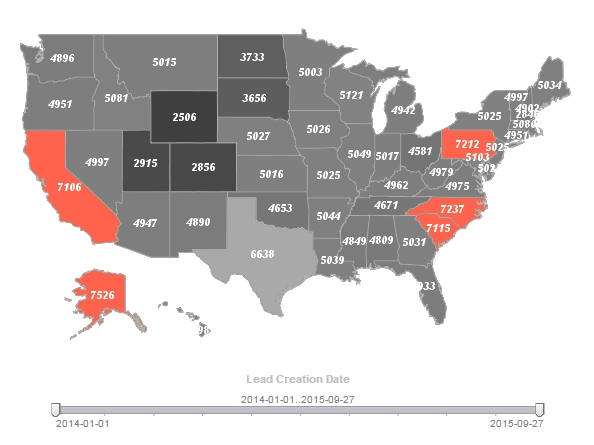 |
Click this screenshot to view a two-minute demo and get an overview of what InetSoft’s BI dashboard reporting software, Style Intelligence, can do and how easy it is to use. |
Aberdeen Group's Agile BI Benchmark Report - Business intelligence technologies are well established in many organizations - half of the organizations that Aberdeen surveys have been using BI for 5 years or more. But, despite this wealth of experience, Aberdeen has found that only 43% of business intelligence projects are delivered on-time or early. Agile BI is business intelligence that can rapidly adapt to meet changing business needs. As emerging business events require managers to have access to new or different information, an agile BI implementation can quickly deliver that information - through manipulation by the business users themselves or by IT professionals...
Ad Hoc Analysis and OLAP Tools - Why do organizations go with an ad hoc analysis approach along with OLAP tools? It's important for organizations to consider a broad spectrum of data to make relevant, informed decisions. In an enterprise reporting environment, it is crucial for organizations to utilize an ad hoc analysis approach along with OLAP tools. Disregarding or missing key information can have adverse effects on any organization. In order to perform a successful and effective analysis on a data set, new and unclear questions should always be answered without hesitation because it's so easy to ignore. To simplify the process, ad hoc analysis and OLAP tools assist in answering anything unclear. At InetSoft, our powerful and intuitive business intelligence solutions guide the process of ad hoc analysis by using OLAP tools. Users will have the ability to analyze multi-dimensional data from different perspectives while answering questions along the way...
Ad Hoc Query and OLAP Were the Sweet Spot for BI - And I think that’s the mindset that a lot of us have had over the last 10, even like 20 years. I mean a lot of these ad hoc query and OLAP tools go back to the early ‘90s, and this notion of ad hoc query and OLAP is the sweet spot for BI. I mean I know I kind of grew up with that mindset that this is the sweet spot. If we can only deliver ad-hoc query and OLAP, we will be able to avoid the problems at the extremes. And the epiphany I had was that ad hoc query and OLAP is not the sweet spot. If we focus on ad hoc query and OLAP, we overshoot our information consumers. No matter how easy we make it to build their own reports, they don’t want to do it themselves. They want someone else to build reports for them, and really interactive reports is the sweet spot for them. Reports that were built where they can use prompts or parameters and drill in a very easy and guided way to information they want to see, but it’s very much an information consumption model. They are not creating their own reports. Along the same lines, if we are overshooting our information consumers, we’re undershooting our power users...
 |
“Flexible product with great training and support. The product has been very useful for quickly creating dashboards and data views. Support and training has always been available to us and quick to respond.
- George R, Information Technology Specialist at Sonepar USA
|
Advanced BI Solution - Looking for advanced BI solutions? InetSoft is a pioneer in self-service analytics whose platform also has built-in machine learning functions. View a demo and try interactive examples...
Advances in Mobile BI - Our agenda today is pretty brief. We will start with a little bit of an overview of the company so everyone has a common background and understanding of our product offering at a high level, and we will stress the new highlights of the Version 11.1 release. Then we are going to demo the version. We will give you an overview of the product as well as highlight what's new. And at the end we will have time for questions and answers so go ahead and type your questions in the q&a panel to your right that you see there on the GoTo Webinar panel. So here is a quick slide about the InetSoft the company. We have been around since ’96, and now the company is over 125 employees in three locations around the world. The product offering is sold to both enterprise customers for their internal use, for the internal BI and dashboard and reporting needs as well as an OEM solution...
Advantages of InetSoft's Small Footprint BI Platform - InetSoft's differentiating strength comes from its small footprint, cloud-first design philosophy. Compared to traditional business intelligence and analytics software, InetSoft's small footprint platform is distinct as it: Requires significantly less computing power and resources Minimizes skill training and administration with an all-in-one web app for analytics, dashboard, reporting, and data preparation, for both professional designers and self-service business users Delivers consistent high performance with an on-demand mini-warehouse that avoids IT heavy processes Continue reading below to learn reasons why...
| #1 Ranking: Read how InetSoft was rated #1 for user adoption in G2's user survey-based index |
|
Read More |
Agile BI - Agile BI, agile data access, really agile data access is all about virtualizing access to disparate heterogeneous data assets that are resident in a data warehouse or in your online transaction processing systems or throughout your ETL and other data integration investments. Really the idea is to enable very responsive, flexible, pervasive information as a service and to deliver all those capabilities into your business intelligence and development efforts. So agile business, which is really what we’re striving for here, making your business model ever more flexible to be able to see new opportunities and fend off threats and turn them to your advantage. Agile business really requires agile data access because really data is at the core of every business and every business model...
Agile BI and Business Requirements - Over the past year, there has been a lot of talk about agile BI again. It seems to have become a buzz word for what is a requirement, a business requirement actually, that needs to be supported in IT and by pretty much everybody in the organization and that’s agility, time-to-market, the ability to adjust deal with dynamics in the market and so forth. You can think of it more broadly than the original term for agile software development. Agile software developers have been around for a long time. And if you just take the software development side, you flip that over to business intelligence and data warehousing, you are probably not going to be real successful with it. You have to look at it much more broadly. There’s a difference between being agile versus doing agile. If we just do agile, we are probably going to be less successful than if we be agile. How can you look at agile as a word versus a methodology? Where do we need to be more agile? Because one of the things that agile doesn’t do a very good job at is looking at the data model...
Agile BI Best Practices - In preparation for this webinar on agile BI, we did quite a bit of research read various industry reports, talked to customers, and read many blogs. The idea for this webinar was generated because our customers have been asking us a lot about agile BI, mobile BI, all these topics that are out there. It seems this is one of the most discussed topics in 2010, and we certainly heart that from our clients, but there remains a lot of confusion as to what exactly it is and today we have synthesized the research. There are several aspects of agile BI that kept coming up. Some thought agile BI referred to applying agile principles, and there are a bunch of agile development principles applicable to BI environments, things like scrum, extreme Programming, and so forth. Well, others thought that it should mean the ability of BI to help an organization become more adaptable, especially to the needs of the end-user...
Agile BI Concept - Those are the companies that are going to succeed and win in the current environment. So now this agile BI concept, what’s really behind it? What’s really tangible or actionable behind it? If you look at what was it taking for companies to survive in the last decade, and I see a very interesting trend that in all the decades proceeding the last one, typically on average about a third of Fortune 1000 companies churned, whether they merge or they go bankrupt or they change their existence to another way, shape and form, but about a third have churned. In the last decade that formula turned upside down, and about two thirds, actually a little more than two thirds of the companies churned so if you look at who is left this, and you find some very interesting results. So for any of you who has ever gone to business school, I am sure so you remember this book. It is a great research book about what it takes it to be great, what it takes to go from a good company to a great company...
Agile BI Is Not Strictly About Reporting - Now Agile BI is not strictly about reporting. It’s about other things. It’s about analyzing. I think that’s a key point because there are several things going on. I mean reporting in the middle is about statically presenting collected data. It’s critical. It’s essential, and it answers the ‘what happened’ question. It’s usually from a single system. It can be printed. Its accuracy is aimed at senior management and generally at that level. There is also the need to actually get data out which is part of the Agile BI environment. At some point you actually need the list of the 30,000 people to do the mailing so that’s not a report that’s an export. Or you’re setting up a meeting for some people if you are on the sale side in San Francisco. You want the highest rated prospects who have not been met in this certain period. That’s a list of 30 people. So there is a whole another part of BI that’s not reporting, it’s slicing and dicing and exploring data...
Agile BI Responding to Cycle of Pain - Agile BI is basically responding to that “cycle of pain” that exists within the industry. The cycle of pain is felt by the operational folks, the tactical staff are dealing with systems that had been designed for senior management. And in fact what happens is, this is sort of something we have been using quite a bit because it captures what a lot of our customers feel, is the customer report requests that the end users come with to answer questions, they take a while they are hard to interpret. They can be interpreted different ways, so you might go back for a segment for mailing, and you need 30,000 names or something, and it ends up with 10,000. It's not enough, so you have got to circle back and may be change the parameters on the prior purchase history or something to get the numbers up, and that’s just as back and forth. The other side is end users will download data into Excel and try to manipulate it there, which is what they are comfortable with. Excel is the number 1 end-user business intelligence tool today, but it’s limited. It’s got some of the data, but it can't bring all the tables in, and it’s hard to slice and dice in more than a couple of fields. It keeps being used because it was hard to get the people give it up. It becomes the shadow data system...
 |
View a 2-minute demonstration of InetSoft's easy, agile, and robust BI software. |
Agile BI - Transforming the Enterprise BI Application Life Cycle - Our mission here with agile BI is to really radically transform the enterprise BI application life cycle. We are seeking to lower complexity and improve productivity and lower cost, especially TCO. From a technology infrastructure perspective, we are helping at the data access and data integration levels. We make it possible to skip ETL processes and other data integration pieces typically used for building data models and data warehouses. Our BI platform offers direct access to almost and data source with the unique data mashup capabilities that other vendors sell as data virtualization. So in one solution you have the necessary data modeling tools plus multi-dimensional or OLAP analysis functions plus advanced data visualization tools plus traditional reporting plus interactive dashboarding...
Aligning BI Strategy with Business Strategy - When we started this Webinar we talked a little bit about BI in general what you can get from it and why a BI strategy is really critical and important. You probably all have seen data like what you see on the slide here today. Clearly, companies who take a more data-driven, fact-driven approach to how they run their company, their organization, they do perform better compared to the competition. And this is certainly why BI is essential. It lets you understand what’s going on and also see the impact and the outcome of decisions in business strategies that you are implementing. So if you take a more data-driven, fact-based, less gut-feel based approach to running your company, definitely, you can expect a competitive differentiation...
Aligning the Right BI Technologies to the Business Needs - In aligning the right BI technologies to the business needs, it’s important to understand change, how to not just deal with it, but embrace it. Be able to adapt to those things faster than the competition and likewise take complexity and make it a friend. I mean use that agility to provide competitive advantage but tame it down to the point where people can actually deal with it. With that kind of a focus on agility, what’s happening again in enterprise architecture is there is sort of a shift away from the classic boxes application, infrastructure, information, data architecture. Fundamentally there is a more of a business capability oriented thinking that might actually live in the business organization. You may call it business architecture because it answers the quetsions, what do we need, what should we be able to do? They may come from product management kinds of folks, strategic planning kinds of folks etc. who then drive the creation of solutions based on their knowledge of what technology should be able to do. In this scenario, IT focuses on how to deliver that BI solution based on the expertise that they have on the different BI systems available...
Alternative BI DW Solution - Looking for alternative BI DW solutions? InetSoft is a pioneer in self-service analytics whose platform makes a data warehouse unnecessary. The platform transforms and mashes up data from disparate source with live connections or high-speed caching. View a demo and try interactive examples...
Alternative to Business Objects - Are you searching for a better BI tool than SAP's Business Objects? Consider InetSoft's Style Intelligence, which offers an agile Web-based solution that is easy to deploy and easier to use. Style Intelligence is a full BI suite that facilitates data exploration and discovery through real-time visualizations and reports. It features a highly user-friendly GUI with support for drag-and-drop end user data mashup or dashboard creation...
Alternative to Microsoft's BI Suite - Are you looking for a good alternative to Microsoft's BI suite? InetSoft's pioneering dashboard reporting application produces great-looking cloud-based dashboards with an easy-to-use drag-and-drop designer. Maximize self-service for business and technical staff. View a demo and try interactive examples...
| #1 Ranking: Read how InetSoft was rated #1 for user adoption in G2's user survey-based index |
|
Read More |
Analytic BI Tools - Are you looking for the best analytic BI tools? Since 1996 InetSoft has been making BI software that is easy to deploy and easy to use. Build self-service oriented dashboards and visual analyses quickly. InetSoft's data mashup engine solves the data access and transformation challenges that other tools cannot. View a demo and read customer reviews...
Analytics and Agile BI - Let’s understand why we are all gathered here today. We are all gathered here today to make some money. I am not talking about business intelligence and analytics and agile BI and big data just for the sake of these technologies. These technologies are all money making technologies. These days we find that enterprises who do not compete, who do not compete on information, who do not run their business by the numbers really can’t make it in to these days. Likely we do have some very tangible proof points that there is a tangible return on investment on BI initiatives from looking at a recent analyst report I found. It’s an annual survey. These are last year’s results. This year is also will come out probably midyear. I don’t really expect a lot of changes. You do see very solid, practically achievable double and triple-digit returns here. Most of these returns we find that they are realized anywhere between 18 and 36 months so somewhere within a 2 year period you can achieve a very tangible return on your business intelligence investments which are probably equally as interesting numbers...
Articles for BI Collaborators - Advantages of Choosing InetSoft's Dashboard System - User-Friendly Interface: Intuitive and easy-to-use interface for both designers and end-users. Drag-and-drop functionality for effortless dashboard creation. Flexible Data Integration: Seamless integration with various data sources, including databases, spreadsheets, and cloud services... Bring SaaS BI to Your Data - Bringing the software to the data, not the data to the software, is a proven winning formula in BI. Data tends to quickly increase in volume, variety, and velocity. If your BI application is deployed geographically far from your primary data source, moving the data to the software will become a bigger and bigger challenge as you grow. Even when data movement is not yet an...
Atlas MongoDB BI Tool - Are you looking for good MongoDB BI tools? InetSoft's pioneering dashboard reporting application produces great-looking web-based dashboards with an easy-to-use drag-and-drop designer. Maximize self-service for casual users and data scientists. View a demo and try interactive examples. The accelerated growth in the use and ease-of-use of BI tools has created the need for a way to make BI more accessible to users across an organization. InetSoft has answered that need perfectly with Style Intelligence, a secure, web-based shared dashboard platform which can be accessed by anyone with a web browser...
Balanced Scorecard Software InetSoft’s balanced scorecard software allows users to track key metrics in real time in order to achieve specific goals and keep the company on track. Balanced scorecards can provide critical updates as often as possible, tracking as many parameters (e.g., sales revenue) as needed. With this software, individuals can set the stage for what needs to be accomplished in the future, as well as lay out a plan for how to achieve that goal. These different parameters can be checked at regular intervals, called triggers, and against different conditions to make sure that company performance is on track. If performance is not on track, specified actions can be put into place such as email notifications, etc...
Before You Select a BI Platform - So you have to go through that whole implementation planning before you select a BI platform. You have to figure out what are the things that I am going to address within that organization. What are the goals that we want to meet, and here are some that are just arbitrary for maintenance organization, and then here is what the expected payback is if they can achieve that change. And that of course is also used then to secure the resources that you are going to have to have in order to succeed with that change. So what are some of the best practices to ensure success? You have to ensure leadership sponsorship, and you have to ensure their commitment. You have to maintain your leaders in that area just like your children. And I’ll give you a little story. So the leadership in an organization, they recognize that there is a need for change. They are going to be onboard with it, and guess what, next month they have another burning platform, maybe some regulatory thing comes out, or they are about to be taken over or whatever. Guess what, their focus shifts. So it is your job as a change agent within this organization to ensure that you keep these people right on focus. And so I call myself a professional nag which is really what I am. So all I do is really I just hold them to what they said they were going to do and remind them of the commitments that they have expressed, and of course, I do a lot of other things too, but that’s the primary part...
 |
Read what InetSoft customers and partners have said about their selection of Style Report as their production reporting tool. |
Before Selecting a BI Solution - Then another question we always think is really important to ask before selecting a BI solution is, why can’t they answer this question today with the analytic tools already in place. Agile BI is not trying to replace traditional reporting systems. It’s trying to complement them. One of those quotes earlier says it’s a new paradigm to enable people to do things in ways they weren’t able to before. So a key question is not just what they’re trying to do but why haven’t they’ve been able to do it and the derivative would be, what would enable them to do that effectively? And then another key question is, how is change going to happen once the questions are answered because, okay, now we get these answers to questions, somehow this is going to impact strategy. It’s going to impact organizational design layout on roles, and the management needs to be open once the story starts coming from the data to make effective changes. We have a client for example where we did a lot of work on their marketing campaigns. And we found out that a lot of their mail, phone and even some of their e-mails were largely ineffective, literally 70% of it. Thirty percent was highly effective...
Best Mobile BI Solution - Are you looking for the best mobile BI solutions? Since 1996 InetSoft has been making BI software that is easy to deploy and easy to use. Get interactive dashboards on Apple and Android devices quickly. The solution offers both native apps and HTML5 delivery via a browser. View a demo and read customer reviews from some of the 3,000+ happy customers...
Best Practices for Aligning BI Support - Now as a result we have this ugly disconnect between business and IT and our customers. So what do we do about this? So luckily there are some answers. It’s not a magic silver bullet. We can’t just wave a magic wand and fix this, but there are some best practices for aligning BI support. There are some lessons learned that we can leverage. All of these best practices and lessons learned are categorized and described in an agile BI framework. It has four components. It’s agile software development, agile organizational structure, agile processes and agile BI platforms and technologies. Let’s go through them one by one. Agile BI software development is probably the most familiar to most of you. I think most of you on the phone I am sure are practicing agile software development in one way, shape or form. BI is a different animal where agile is infinitely more important and more relevant than any other software development for multiple reasons...
Best Practices for Solution Providers to Follow When Embedding BI? - Embedding Business Intelligence (BI) into solutions requires careful planning and execution to ensure seamless integration and optimal user experience. Here are some best practices for solution providers when embedding BI: Understand End-User Needs: User Persona Analysis: Conduct a thorough analysis of end-user personas to understand their specific needs, preferences, and skill levels. Feedback Loops: Establish mechanisms for collecting and incorporating user feedback throughout the development and integration process. Prioritize User Interface (UI) and User Experience (UX): Intuitive Design: Create a user-friendly and intuitive interface that allows users to easily navigate and interact with BI features. Consistent Design Language: Maintain consistency in design elements and user interactions across the embedded BI solution and the host application. Ensure Seamless Integration: APIs and SDKs: Provide well-documented and robust APIs and SDKs to facilitate smooth integration with the host application. Compatibility Testing: Rigorously test the embedded BI solution across different environments and versions to ensure compatibility. Focus on Performance Optimization: Data Processing Efficiency: Optimize data processing and retrieval to ensure fast and responsive BI performance. Caching Mechanisms: Implement effective caching mechanisms to enhance performance and reduce the load on underlying data sources...
Best Web Based BI Tools - Are you looking for the best web based BI tools? Since 1996 InetSoft has been making BI software that is easy to deploy and easy to use. Build self-service oriented dashboards and visual analyses quickly. InetSoft's data mashup engine solves the data access and transformation challenges that other tools cannot. View a demo and read customer reviews...
BI Analytics Trends: Big Data - First, as background, for those of you who aren’t familiar with InetSoft, what we really do is help businesses get access to data so they can make better operational decisions. We are a software maker that’s 100% focused on business intelligence and analytics in a variety of industries. And our number one goal is to help companies do everything from building a strategic roadmap of how they can get access to data and how they can get it into the hands of the people who need it. We do the hardcore reporting development so business users can actually visualize that data. What’s interesting is even with the economic downturn we are seeing a lot more companies really focusing on using data as a corporate asset. We are seeing financial firms, manufacturing and retail being really big drivers of modernizing information management. For the first time they are saying, hey I have all these data silos. How can I get access to all of that siloed data, so I can create a comprehensive view of my business...
BI Application - Information for those looking for a standalone BI platform, or to embed an application in a BI portal. Benefits include: easy enough to be, deployed in weeks, not months, learned by new users with minor training, and used without the aid of a BI expert...
BI Application Development World - So having gone through all of that in the BI application development world, they use the what I call use cases, and they have these business use scenarios that need processes, and the question is, is there an equivalent, or was there an equivalent for a BI solution. And this is where we started about three four years ago trying to see if anything was out there that will allow us to really automate the business modeling part of the BI solution, and the answer is absolutely there are business BI modeling tools, prototyping tools. The one that we use regularly and on just about every project we have done in the past two to three years is the Balanced Insight consensus tool. And the reason we like the consensus tool is because it serves a lot of values and plays a lot of roles. It is the start of business of definition collection so we can actually becomes the repository for the glossary. We could also do the synonyms. It will maintain the hierarchy of business relationships in terms of how entities and hierarchies relate. It does have the processing engine, the data stewardship, and it auto generates this is really cool stuff. This is why we can do sprint zero so quickly and so cost effectively. It auto generates the BI semantic layers as well as other BI tools, and it also can auto generate virtual models, and it can auto generate database, physical database and database schemas like cubes we see here...
BI as a Service - Are you looking for an option for BI as a service? Business intelligence pioneer InetSoft's cloud-based platform offers maximum self-service, personalized dashboards, data mashups. Create great-looking web-based analyses and reports with an easy-to-use drag-and-drop designer. Get personalized mentoring services included for free. View a demo and try interactive examples...
BI Best Practices - Business intelligence software allows users to create reports and dashboards to monitor their business, as well as many more functions to aid operations. They combine executive information systems with IT functionality to provide a framework for your business. If your organization utilizes business intelligence software properly, it can greatly aid overall performance. This is why you should keep certain BI best practices in mind when starting a BI venture. Software like this has only gotten better with time. Here are the BI best practices that every business should follow to be successful in a BI environment...
|
“Flexible product with great training and support. The product has been very useful for quickly creating dashboards and data views. Support and training has always been available to us and quick to respond.
- George R, Information Technology Specialist at Sonepar USA
|
BI Best Practices from an Analyst - An industry analyst offers these best practices when considering and deploying BI: 1. Place a broadly defined BI process, one that goes beyond dashboards to include analytics front and center of all CRM activities. Insist that businesses, in partnership with IT own CRM data and metrics "If firms look at BI as just another technology and tool and relegate management of BI activities to IT department that is a sure recipe for disaster," he points out. 3. Practice top-down CRM performance management (define strategy; define supporting goals and objectives, and identify metrics needed to monitor goals and objectives...